Rechargeable hearing aids: how many hours does the battery really last?
Phonak research · 16 September 2026 · 6 min read
“Will the battery last the whole day?” It is the question we hear at every first appointment, right after the one about price. The manufacturers’ answer comes in two words, “up to”, followed by a number of hours. Those two words deserve a closer look, because they make all the difference between the brochure and your daily life.
We take the example of Phonak’s Audéo EON Sphere, advertised as “up to 38 hours”. What we explain applies to every rechargeable hearing aid.
What “up to 38 hours” means
The figure is the maximum runtime of the lithium-ion battery, on a single charge, under favourable conditions. Favourable means three things at once: a mild to moderate hearing loss, so amplification that needs little power; little or no audio streaming from the phone or the television; and days spent in quiet surroundings, where the speech-in-noise programme does not need to switch on.
Phonak says so in a footnote: actual runtime depends on the individual’s hearing loss, streaming, listening environments, activated features, and the age of the battery. “Up to” is therefore not a promise for everyone. It is a ceiling.
The number that matters for planning: 22 hours
The official Audéo EON Sphere datasheet gives a second, less visible value: an expected operating time of 22 hours. That is the one we use in our centres. The example Phonak gave at launch matches it: a day that includes 8 hours of audio streaming and time spent in noisy environments, where the power-hungry artificial intelligence chip is at work.
In our practice, the profile that lands around 22 hours is clear: a moderate to severe hearing loss, moderate streaming (calls, television, some music) and a few hours a day in noise, at the restaurant, in meetings or with family. That is the profile of most people who choose a Sphere model, precisely for its performance in noise.
Twenty-two hours is still a full waking day, with margin. One charge every night is enough. The difference between 22 and 38 only matters if you forget to charge, or if you leave for two days without the charger.
Why noise and streaming use so much power
Three things share the battery. Amplification, first: the greater the hearing loss, the more acoustic power the device has to produce, all day long. Streaming, second: receiving sound from a phone or a television keeps the Bluetooth radio link active, which costs more than listening to the world through the microphones. Speech separation in noise, third: on a Sphere model, it is a second processor that switches on as soon as the environment becomes loud and complex. It is the device’s strength, and it is also the feature that uses the most power.
What has changed compared with the previous generation
The first Sphere generation had solved speech understanding in noise, but at the cost of a power draw that was a problem for heavy users. In our centres, we saw devices of that generation arrive flat at the end of the day on people who streamed a lot and spent their evenings in noise.
For the EON generation, Phonak announces a speech-in-noise feature that uses 37% less energy. The manufacturer chose to invest that gain in two directions: a noticeably smaller and lighter housing, and an artificial intelligence programme that can switch on earlier and stay active longer without compromising runtime. The maximum runtime advertised stays in the same range; what changes, in our experience, is the hard day, the one with a lot of streaming and noise, which no longer ends with an empty battery.
Charging day to day
A full charge takes about two and a half hours, down from three hours on the previous generation. One hour of charging restores about 55% of the battery: enough to cover an evening if you forgot to charge the night before.
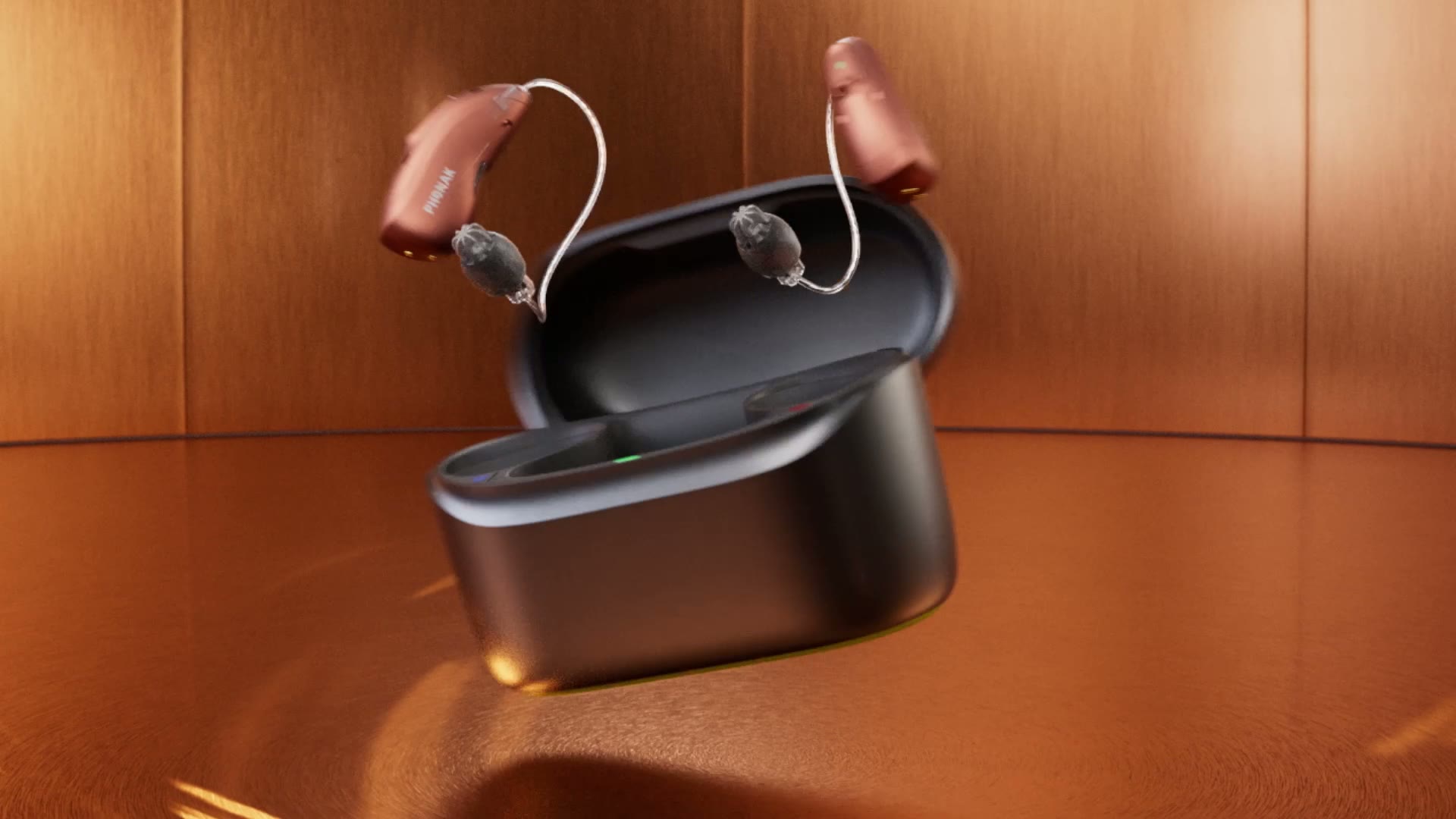
The device is rechargeable only; there is no disposable-battery version. The charging case is included. As an option, the ChargerGo portable charger carries its own battery and provides up to three additional full charges without a power outlet: it is the accessory for travel, hiking weekends and long days away from a socket.
And the Audéo EON R, without the artificial intelligence chip?
The Audéo EON R, the standard model in the same range, shares the same housing but does not carry the second processor. Its datasheet lists an expected operating time of 29 hours, against 22 for the Sphere. If you spend little time in noise and runtime is your first criterion, the question is worth raising with your hearing care professional. Both models are on our prices page.
What changes over the years
Like a phone’s, a hearing aid’s lithium-ion battery loses capacity with age and charging cycles. After several years, runtime is lower than on a new device. It is something we check at follow-up appointments: if your device no longer lasts the day when it used to, tell us, the manufacturer offers a battery replacement.
In practice
Charge every night, like a phone: the case is designed for it. If you go away for several days without a socket, take the ChargerGo. If you stream television for several hours every evening, plan on 22 hours, not 38. And during the free three-week trial our centres offer, test your longest days specifically: that is where the runtime question is settled, not in a brochure.
What Phonak says exactly, and the limits
The figures in this article are manufacturer specifications: up to 38 hours under favourable conditions, 22 hours expected operating time on the datasheet, about 2.5 hours for a full charge, 29 hours expected for the Audéo EON R. No independent runtime test of the Audéo EON Sphere has been published to date. The 38-hour maximum assumes light use, which does not match the daily life of most people who choose a Sphere model. The 37% reduction in power draw is also a manufacturer-stated value. The “in our centres” observations are our own, on a limited number of patients, and do not replace a measurement.
Sources
Sonova AG (24 August 2026). New EON hearing aid portfolio strengthens Phonak’s leadership in speech understanding, scene intelligence and Made-For-All connectivity. Press release, Stäfa. States up to 38 hours of battery life on a single charge, with the footnote on hearing loss, streaming, environments and battery condition.
Phonak Audéo EON Sphere product datasheet (2026), via phonak.com. Lists 22 hours expected operating time, 38 hours maximum, about 2.5 hours for a full charge; 29 hours expected for the Audéo EON R.
HearingTracker (August to September 2026). “Phonak Audéo Eon Review” and “Phonak Eon Debuts Smaller Sphere, Auracast, and WindBlock”, hearingtracker.com. Reports the 22-hour example with 8 hours of streaming, the 2.5-hour charge time and the ChargerGo’s three additional charges.